The most powerful car starter battery ever on the market, the LBC90SP, 2500 CCA!
And 95 (true) Ah.
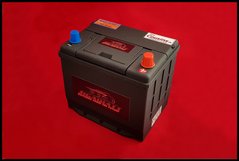
The LBC40SP is the mid-range battery in the series with 1,500 CCA and 40 Ah.
The LBC40SP is a 1500 CCA, 40 Ah battery —tested here on a Checy with a 5.3-liter engine, which originally came with an 80 Ah lead-acid battery
Product Presentation LBC-SP
True Cousins is proud to be the first to offer this second-generation lithium-iron starter battery for cars, which we have named LBC-SP, where the "S" stands for safety features. It is, in fact, the first battery of its kind with built-in safety in the form of both under-discharge protection and protection against overcharging (excessive voltage)—and NOW also overcurrent protection = Protection = P.
P also stands for even more power—this should be viewed in comparison to the previous LBC-S series, where the starting power has now increased by approximately 50%.
All in all, this is the first time a lithium starter battery for cars has become available in Denmark, and we have invested a great deal of time and resources into finding this particular battery, which is currently the most affordable and highest-quality lithium starter battery for cars—as such, the smallest battery in the series, the LBC20SP with 22 Ah, costs about the same as our most powerful motorcycle battery (LBB20S), which is 16 Ah.
What do these safety features mean?
The discharge function means that if, for example, you forget that you have a device in the car that is draining the battery, it will automatically shut off when the voltage drops below 8 volts—and the battery will NOT be damaged or suffer any harm.
The same applies to the overcharge protection feature, which automatically shuts down the battery if it is charged at more than 15.6 volts. Without this feature, you risk COMPLETELY DESTROYING the battery, as it cannot withstand much more than 17–18 volts—this also applies to lead-acid batteries.
This situation can occur if you charge the battery using an old-fashioned, non-smart charger or if the car’s charge controller burns out. Finally, you could also damage the control board (BMS) inside the battery, which would ruin the battery cells.
IMPORTANT INFORMATION
We have found that most people (understandably) have become accustomed to the fact that the operating voltage for a lead-acid battery is 12 to approximately 12.8 volts. We have found that many of our new customers assume this also applies to their new Jigawatt lithium starter battery, but this is NOT the case.
Many people know that a lithium battery has a somewhat higher output voltage when fully charged (14.4 volts, which brings a number of advantages, described elsewhere), but very few realize that 90% of the effective energy lies within a very narrow range of 13 to 13.6 volts. And where 12.8 volts (which is perfectly fine for a lead-acid battery) is equivalent to COMPLETELY DISCHARGED.
Attempting to start a discharged lithium battery multiple times in a row can result in its complete destruction. A lead-acid battery certainly cannot withstand this either, but it will "die" a bit more slowly.
It is therefore important to have a good handle on the voltage BEFORE attempting to start the vehicle. If there is no or very little power consumption while the vehicle is stationary, the lithium battery can hold its charge for a very long time—much longer than a lead-acid battery can.
However, we have found that as long as the vehicle’s power cables are connected to the battery, there is in most cases some consumption in the form of leakage current due to moisture, as well as consumption from alarms, GPS trackers, clocks, etc.
After a while, you’ll figure out approximately how long you can expect the battery to retain enough voltage (to start the vehicle) while stationary and uncharged—either via the battery’s built-in voltmeter or by using an external voltmeter.
NEWS: Overcurrent Protection
As a brand-new feature, we now have overcurrent protection (OCP), which means that if you try to draw too much current from the battery, the battery will shut down to protect the cells from being damaged.
If this happens, you will need to disconnect the power cable from one of the battery terminals to reset the security system.
Why are lithium batteries so much better than lead-acid batteries?
Den vel nok største forskel er, at et blybatteri (fra første startforsøg) løbende falder i spænding og allerede efter eksempelvis 10 gode startforsøg vil man opleve, at man direkte kan høre startmotoren køre langsommere og langsommere. Dette skyldes, at den såkaldte indre modstand stiger i takt med, at kapaciteten forbruges (antal Ah) og allerede, når man har brugt blot 25-30% af kapaciteten, vil blybatteriet falde så langt ned i spænding under startforsøget (< 10 volt), at man ikke længere kan starte - dette skyldes at omdrejningshastigheden bliver for lav og at tændingssystemet ikke kan fungere ved alt for lave spændinger.
When it comes to the lithium starter battery, the situation is quite different—and much more favorable. Lithium batteries generally experience less voltage drop under load, but more importantly, they do NOT experience a continuous drop in voltage as you begin to use their capacity.
This means you can achieve 4 to 6 times as many SUCCESSFUL STARTING ATTEMPTS (i.e., 40–60) compared to a lead-acid battery.
Another key factor is that the voltage reaching the ignition system from the lithium starter battery under load is somewhat higher than that from the lead-acid battery. Data logs we have collected ourselves show that the Jigawatt starter battery delivers up to 1.5 volts higher voltage under heavy load (starting attempts) compared to the lead-acid battery, which is a huge advantage for all ignition systems—and can also be an advantage in certain high-performance vehicles that may have various subsystems that function better at a higher voltage, e.g., fuel pumps, gearshift systems, etc.
Furthermore, the internal resistance DECREASES as the number of starting attempts increases, since the battery heats up due to the many starting attempts (internal resistance decreases as temperature rises), which in turn means that the starting current actually increases. This effect generally does not occur with lead-acid batteries, since their thermal mass is too great for the battery to heat up enough for it to have any significant impact.


This is clearly shown in the graph above, where you can see that the lithium battery has an almost completely flat discharge curve and only drops at the very end, when approximately 5–10% remaining, whereas for the lead-acid battery, the voltage drops steadily as the capacity is used up and has already fallen below 10 volts when approximately 30% of the capacity has been consumed.
The consequence of this is also that if, for example, you have a 60 Ah lead-acid starter battery rated at 500–600 cold cranking amps (CCA), you actually only have (30% of 60 Ah) 18 Ah available for starting attempts —or to put it another way: You’re driving around with a large, heavy battery weighing 16–18 kg, where you can actually only use 30% of it for starting attempts; the remaining 42 Ah and many kilograms of lead are, in this context, useless.
By comparison, a 20 Ah lithium battery is sufficient; as described earlier, at least 90% of its capacity can be used for starting, which corresponds to exactly (90% of 20 Ah) 18 Ah —such a battery weighs 3.4 kg and is called LBC20S and has a CCA rating of 900.
The real reason for the significant difference in performance lies in the differences in chemistry and construction between the two battery types, with lithium batteries having an energy density (Wh/kg) that is approximately four times higher. It should also be noted that the lead-acid battery is essentially an invention from 1859, while lithium-ion starter batteries entered the market around 2015 and are continuously being developed and improved.
From a technical, performance, and environmental standpoint, the lead-acid battery is likely to soon have outlived its usefulness as a starter battery, and a steadily growing number of motorcycle and car manufacturers are beginning to install lithium-ion starter batteries in their new models.
Jigawatt LBC-SP vs. the best lead-acid batteries
But most importantly, the LBC-SP series offers extremely high CCA ratings due to exceptionally low internal resistance. For example, the LBC60SP has an incredible 2000 CCA and an internal resistance of approximately 2 mΩ!
And the other, smaller batteries in the LBC-SP series are just as impressive in terms of their CCA ratings, both in terms of size and weight, when compared to top-of-the-line lead-acid batteries such as Optima and Odyssey.
For example, you need to go with an Odyssey PC2150 to get 1,150 CCA. This battery weighs a full 35 kg and is rated for 400 charge cycles. By comparison, the Jigawatt LBC40S costs a little less but delivers 1,300 CCA, weighs just 6.5 kg, and has a minimum of 1,500 charge cycles—so if you’re looking for lower weight, high performance, and a long service life, it makes sense to choose the Jigawatt LBC40SP.

LBC40S (the predecessor to the LBC40SP) – shown here installed in one of Denmark’s most stunning hot rods – the engine delivers 1,300 hp!

LBC40S installed in a Chevy Suburban 1500 LT 4WD with a 5.3-liter V8 engine.

Classic Japanese car with a Wankel engine, shown here with the LBC30S.
Extremely long standby and battery life
The self-discharge rate of a lead-acid battery is typically 10–20% per month, which means that a lead-acid starter battery must be charged regularly; if you forget to do so for too long, you risk completely ruining the battery.
With the LBC-SP, it’s a completely different story. The self-discharge rate is approximately 1% per month, which in practice means that when the battery is fully charged, it can be left for at least two years without recharging and still be ready for use!
When it comes to lifespan, it’s the same story. A typical lead-acid battery lasts for 300–400 charge cycles before it dies, while the LBB-S lasts for about 1,500 charge cycles—or at least four times as long.

The LBC-SP series now features a built-in digital voltmeter with a push button

LBC60SP-0 - The polarity is 0, since the positive terminalis on the right

All LBC-SP batteries in the online store are accompanied by images showing their dimensions


SPECIFICATIONS | Jigawatt LBC20SP | Jigawatt LBC40SP | Jigawatt LBC60SP | Jigawatt LBC90SP |
Battery technology | Lithium iron phosphate (LiFePO4) | Lithium iron phosphate (LiFePO4) | Lithium iron phosphate (LiFePO4) | Lithium iron phosphate (LiFePO4) |
Physical dimensions (L x W x H) | 196 x 127 x 202 mm (+19 mm poles) | 235 x 173 x 180 mm (+17 mm poles) | 279 x 175 x 187 mm (+0 mm terminals) | 279 x 175 x 187 mm (+0 mm terminals) |
Weight | 3.40 kg | 6.50 kg | 8.10 kg | 11.70 kg |
Terminal type | Type 1, Ø19.5/17.9 mm | Type 1, Ø19.5/17.9 mm | Type 1, Ø19.5/17.9 mm | Type 1, Ø19.5/17.9 mm |
Pole position | 0 = (+) right = default | 0 = (+) right = default | 0 = (+) right = default | 0 = (+) right = default |
Nominal voltage | 13,2 V | 13,2 V | 13,2 V | 13,2 V |
Maximum discharge current, CCA | 900 A, 2–5 seconds at a time | 1500 A, 2–5 seconds at a time | 2000 A, 2–5 seconds at a time | 2500 A, 2–5 seconds at a time |
Internal resistance (ohmic measurement) | 3.3 mΩ | 2.4 mΩ | 2.1 mΩ | 1.0 mΩ |
Typical CCA according to the SAE standard | 300–500 A | 500–750 A | 600–800 A | 700–1,000 A |
Tested capacity | 20 Ah | 40 Ah | 60 Ah | 95 Ah |
Equivalent capacity, starter battery | 40–60 Ah | 60–150 Ah | 100–220 Ah | 150–300 Ah |
Built-in voltmeter | Yes, push button, auto-off | Yes, push button, auto-off | Yes, push button, auto-off | Yes, push button, auto-off |
Charging, max. charging current | 60 A | 120 A | 180 A | 270 A |
Charging voltage | 13.5–15.6 volts | 13.5–15.6 volts | 13.5–15.6 volts | 13.5–15.6 volts |
Charging method | - The car's own charging system - Smart chargers such as: Victron Automotive 5, 15, or 25A Blue Smart | - The car's own charging system - Smart chargers such as: Victron Automotive 5, 15, or 25A Blue Smart | - The car's own charging system - Smart chargers such as: Victron Automotive 5, 15, or 25A Blue Smart | - The car's own charging system - Smart chargers such as: Victron Automotive 5, 15, or 25A Blue Smart |
Self-discharge | <1,0% per måned | <1,0% per måned | <1,0% per måned | <1,0% per måned |
BMS, cell balancing | Yes | Yes | Yes | Yes |
BMS, safety function Charging | Yes, max. 15.6 V (The battery turns itself off) | Yes, max. 15.6 V (The battery turns itself off) | Yes, max. 15.6 V (The battery turns itself off) | Yes, max. 15.6 V (The battery turns itself off) |
BMS, safety function Discharge | Yes, below 9.5 V (the battery shuts itself down) | Yes, below 9.5 V (The battery shuts itself down) | Yes, below 9.5 V (the battery shuts itself down) | Yes, below 9.5 V (The battery shuts itself down) |
BMS, safety function Overcurrent protection | Yes | Yes | Yes | Yes |
Vibration-tested | Yes | Yes | Yes | Yes |
Puncture-tested | Yes, batteries CANNOT catch fire | Yes, batteries CANNOT catch fire | Yes, batteries CANNOT catch fire | Yes, batteries CANNOT catch fire |
Ambient temperature | -25°F to +80°F | -25°F to +80°F | -25°F to +80°F | -25°F to +80°F |
Temperature during charging | Avoid severe frost | Avoid severe frost | Avoid severe frost | Avoid severe frost |
Expected lifespan | Ages 8–13 / min. 1,500 full-time charge cycles* | Ages 8–13 / min. 1,500 full-time charge cycles* | Ages 8–13 / min. 1,500 full-time charge cycles* | Ages 8–13 / min. 1,500 full-time charge cycles* |

Copyright True Cousins © All Rights Reserved